The future of generative AI is transitioning from a period of "novelty and hype" into an era of deep, structural integration. As we look toward the late 2020s, the technology is evolving from simple chatbots into sophisticated agentic systems capable of autonomous reasoning and multi-step execution.
1. The Rise of Agentic AI
We are moving beyond reactive models that simply "chat." The next generation of generative AI consists of autonomous agents that can plan, reason, and execute complex workflows. Instead of merely drafting an email, these agents will manage entire projects—coordinating calendars, negotiating with vendor APIs, and self-correcting when errors occur. This shift transforms AI from a digital assistant into a proactive collaborator that operates with minimal human oversight.
2. Multimodal Mastery
The distinction between text, image, audio, and video models is rapidly disappearing. Future models are being built as natively multimodal, meaning they process all forms of data simultaneously, much like the human brain. By 2026, it will be common to show an AI a video of a mechanical failure, provide a snippet of the grinding sound it makes, and receive a narrated, 3D-annotated repair guide in real-time. This "Hollywood in a box" capability is also democratizing high-end content creation, allowing small teams to produce cinematic-quality media.
3. Domain-Specific "Small" Models
While
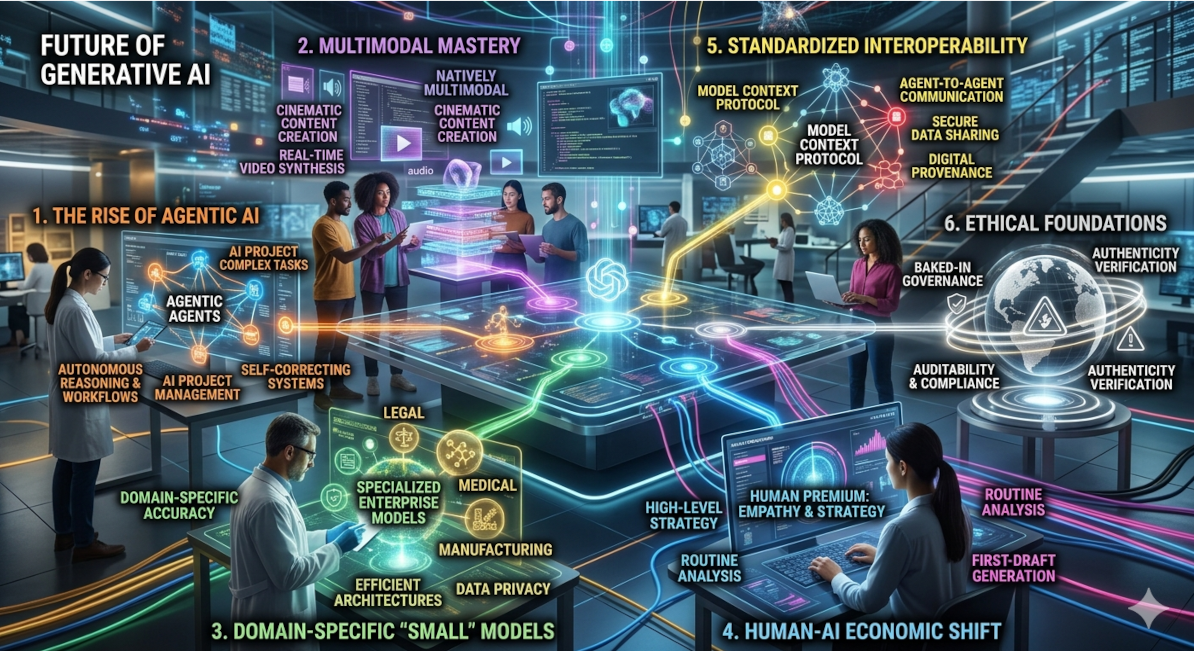
4. The Human-AI Economic Shift
As AI handles more routine and analytical tasks, the "human premium" is shifting toward judgment, empathy, and strategic intuition. We are seeing a move away from "process optimization" (doing the same thing faster) toward "process redesign" (reimagining how work happens entirely). While this raises concerns about job displacement in administrative sectors, it also creates a "new era of productivity" where humans focus on high-level creative direction while AI manages the heavy lifting of data synthesis and first-draft generation.
5. Standardized Interoperability
As millions of AI agents come online, the new bottleneck is communication. We are seeing the birth of the "Agent Internet"—a set of standardized protocols (like the Model Context Protocol) that allow agents from different companies to talk to one another securely. This interoperability will enable a "plug-and-play" ecosystem where a company’s compliance agent can automatically interface with a partner’s logistics agent to verify an audit trail without manual human intervention.
6. Ethical and Regulatory Foundations
The "wild west" era of generative AI is being reined in by global regulatory frameworks and advanced safety guardrails. Future systems will feature baked-in governance, where identity, permissions, and auditability are part of the model’s core communication layer. As deepfakes and AI-generated misinformation become more sophisticated, the focus is shifting toward "digital provenance"—standardized watermarking and verification systems that help users distinguish between human-generated and synthetic content.
The digital era demands agility, and businesses that can’t adapt quickly risk falling behind. Cloud and DevOps services are at the heart of modern IT transformation, and Glomex Technologies provides solutions that give businesses the competitive edge.
Cloud computing
Managing projects is more complex than ever. Remote teams, multiple stakeholders, and tight deadlines make traditional methods ineffective. Project management tools have become essential, and at Glomex Technologies, we create platforms that simplify collaboration and enhance productivity.
Our tools
For businesses that rely on physical transactions, Point-of-Sale (POS) systems are critical. They don’t just process payments—they manage inventory, track sales, and provide valuable insights into customer behavior. At Glomex Technologies, we design POS systems that go beyond transactions
The retail landscape has changed forever. Consumers now expect seamless online shopping experiences, personalized recommendations, and secure payment systems. At Glomex Technologies, we build cutting-edge e-commerce platforms that help businesses tap into this digital revolution.
E-commerce isn’t just about
© Glomex Technologies. All Rights Reserved.