Software development has always evolved alongside new tools and technologies. From assembly language to high-level programming languages, from manual coding to frameworks and low-code platforms, each advancement has aimed to make building software faster and more accessible.
Today, Generative Artificial Intelligence (Generative AI) is driving the next major transformation: Text-to-Software development.
Instead of writing hundreds or thousands of lines of code, developers can now describe what they want in natural language and have AI generate working software components. This shift is changing how applications are designed, built, and deployed.
What is Generative AI?
Generative AI refers to artificial intelligence systems capable of creating new content such as text, images, music, videos, and even software code.
These systems are trained on massive datasets and learn patterns that allow them to generate outputs similar to human creations.
Popular applications of generative AI include:
Content writing
Image generation
Code generation
Data analysis
Chatbots and virtual assistants
In software engineering, generative AI has enabled tools that can generate code, design systems, and even build entire applications from simple prompts.
Understanding Text-to-Software
Text-to-Software is a development approach where users describe a software system using natural language, and an
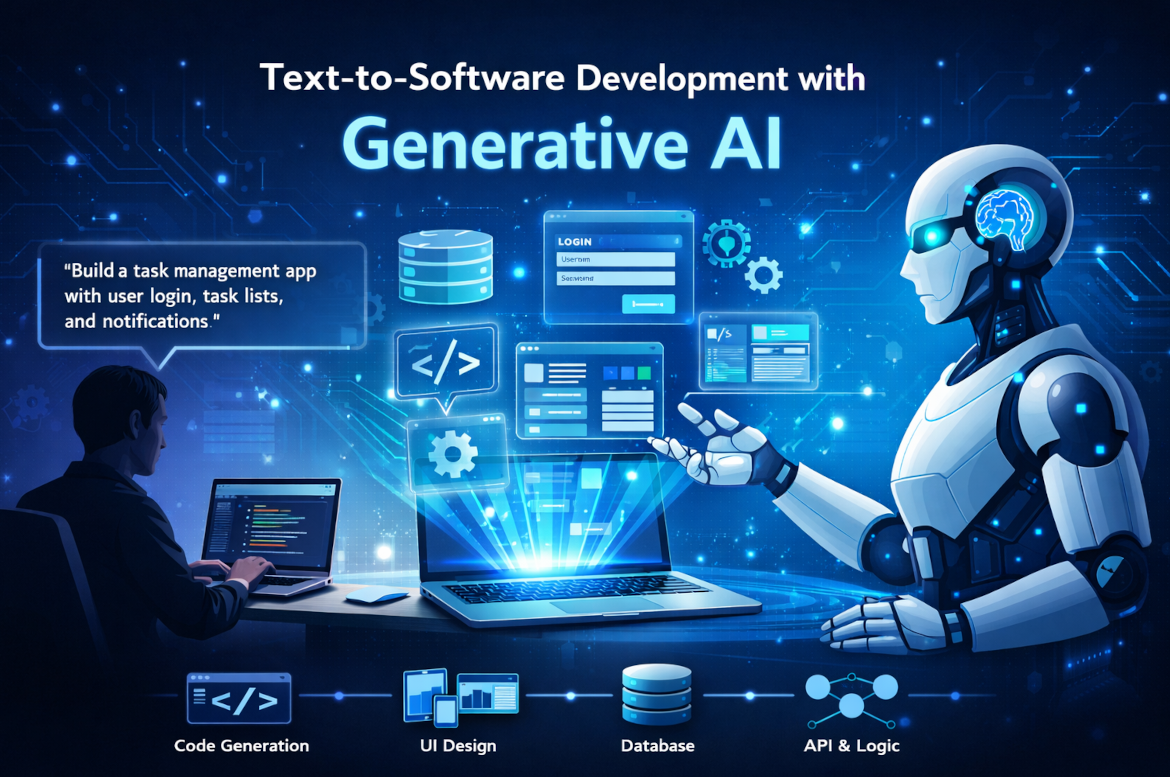
For example, a user might write:
"Create a web application for managing student registrations with login, dashboards, and reporting."
A text-to-software system could automatically generate:
Database schema
Backend APIs
Authentication systems
User interface pages
CRUD operations
Deployment configuration
Essentially, the description becomes the blueprint for the application.
How Text-to-Software Works
Most text-to-software systems rely on several key technologies:
1. Large Language Models (LLMs)
LLMs understand human language and translate it into structured instructions or code.
They interpret requirements such as:
System features
Data models
Business rules
User interfaces
2. Code Generation Engines
These engines convert interpreted requirements into actual code using programming frameworks such as:
Laravel
Django
Node.js
React
Flutter
3. Automated Architecture Generation
Modern systems automatically design:
Microservices
APIs
Database relationships
Authentication mechanisms
4. Continuous Iteration
Users can refine their application simply by updating the prompt.
Example:
"Add payment integration and role-based access control."
The AI updates the system without manual coding.
Benefits of Text-to-Software
1. Faster Development
Applications that previously took months can now be created in hours or days.
2. Lower Development Costs
Organizations can build systems with smaller development teams.
3. Accessibility
Non-programmers can participate in software development by describing requirements in plain language.
4. Rapid Prototyping
Startups and innovators can test ideas quickly without heavy engineering investment.
5. Increased Developer Productivity
Developers can focus on architecture and innovation rather than repetitive coding tasks.
Challenges and Limitations
Despite its advantages, text-to-software development still faces challenges.
1. Code Quality
Generated code may require optimization and refactoring.
2. Security Risks
AI-generated code may introduce vulnerabilities if not properly reviewed.
3. Complex Systems
Highly complex enterprise systems still require human expertise and architecture design.
4. Dependency on AI Models
Performance and accuracy depend on the quality of the underlying AI model.
The Future of Software Development
Text-to-software development represents a fundamental shift in how software is created. Instead of focusing on syntax and manual implementation, developers will increasingly focus on:
Problem definition
System architecture
AI orchestration
Quality assurance
In the near future, we may see platforms where users can simply say:
"Build me a university management system with admissions, finance, and reporting."
And within minutes, a complete system is generated, tested, and deployed.
Conclusion
Generative AI is redefining software development by enabling text-to-software creation. This innovation is making software development faster, more accessible, and more efficient.
While human expertise will always remain essential for design, security, and scalability, AI will become a powerful collaborator in building the next generation of digital systems.
The future of development may not begin with writing code—but with writing ideas.
Customer relationships are the lifeblood of any organization. A robust Customer Relationship Management (CRM) system helps businesses capture leads, manage sales pipelines, and build lasting customer loyalty. At Glomex Technologies, we develop tailor-made CRM systems that give businesses the
In today’s fast-paced economy, businesses cannot afford to operate in silos. Enterprise Resource Planning (ERP) systems provide the backbone for modern organizations, integrating departments such as finance, HR, procurement, logistics, and sales. At Glomex Technologies, we specialize in creating
© Glomex Technologies. All Rights Reserved.